
Click here for last year's AGM documents
View the reports by clicking or tapping the title.
Minutes
Minutes of the 55th Annual General Meeting of the Ramblers (Lancaster Group) 19:00 on Thursday 14 November 2024 at the Friends Meeting House, Lancaster.
1. Present: 21 members
Apologies: Cynthia Seymour, Don Walker, Jean Walker, Judy Steele, Liz Leach, Maureen Leach, Nina Brindle
2. Minutes of previous meeting – approved.
3. Matters arising
Saturdays and Sundays for weekend walks, Tuesday and Thursday for summer evening walks and archive of walks are now available on the website.
4. Treasurer’s report (David Todd)
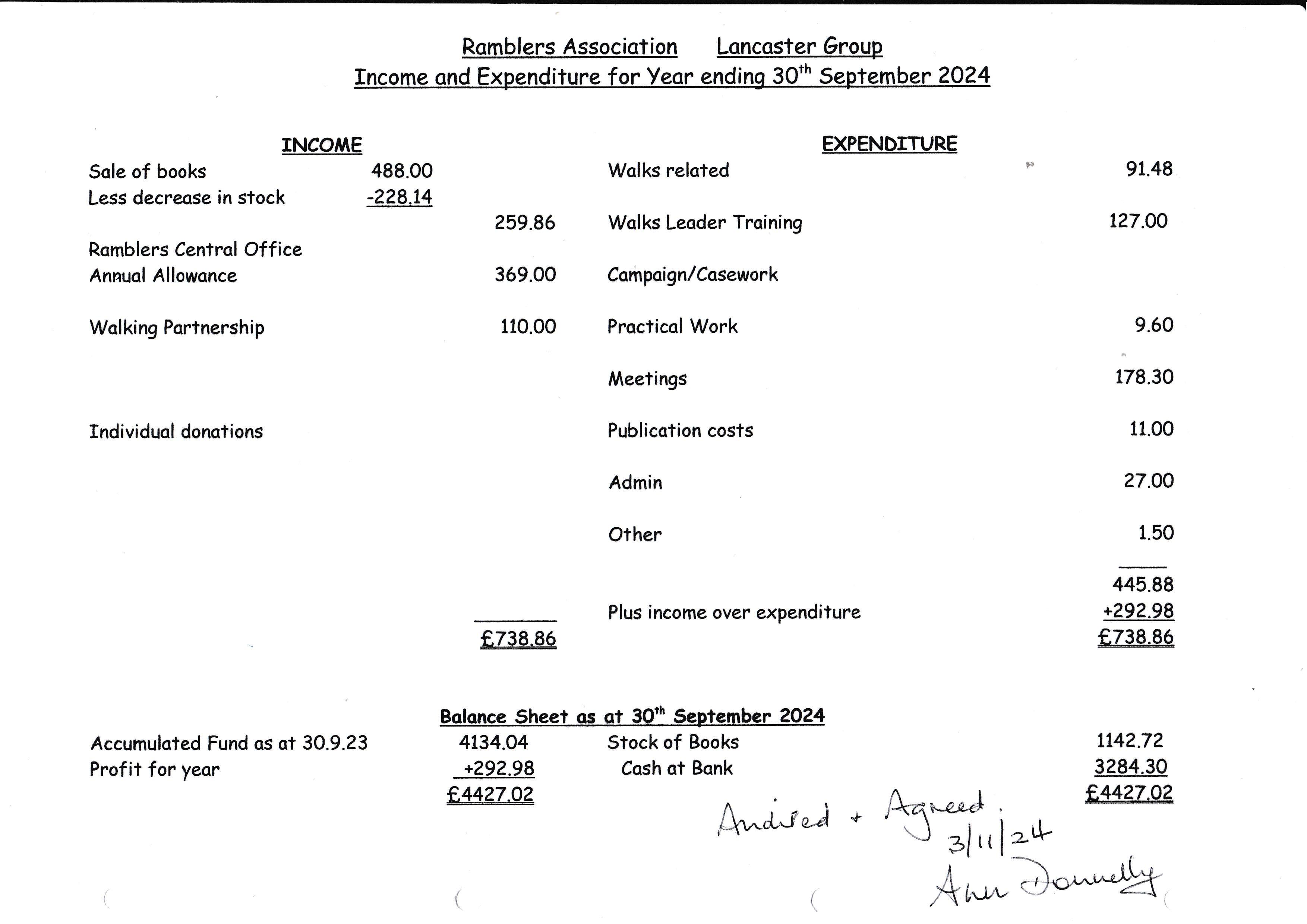
Ramblers booklets – strong sales in 2023/24 but outlets are going down, particularly within the museum services. Members are encouraged to raise awareness of the booklets at local cafes and garden centres, in case they might like to sell them. We’ve spent less on walk leader training this year. We get money from Walking Partnership when members book holidays with Ramble Worldwide and mention the Lancaster Group. We get an annual allowance from Ramblers Central Office. Thanks to Ann Donnelly for auditing the accounts. Accounts accepted unanimously.
5. Secretary’s report (Sue Pope)
Thanks to Sandra Todd (webmaster) and David Johnson (Technical Support) for all their work Question about Coastal Path – big, slow job. Two issues: have to use a train between Grange and Ambleside, Warton salt marsh has a fence between the route and the marsh, despite it being access land.
6. Programme Secretary’s report (Judy Steele)
Thanks to Judy for all her work on the walks programme. Reminder of mentoring scheme for aspirant walk leaders. Reminder of walk leaders’ day on 8 March 2025.
7. Footpath Secretary’s report (Neil Herbert & Jean Walker)
When reporting problems, please don’t forget to include the grid reference along with a photo and date.
Lost Ways is a small group and Joy will soon be moving on. Neil is coordinator for Lancashire, Brian is coordinator for Cumbria. If you’re interested in getting involved, please contact Neil. Jack Cornish has just written a book on Lost Paths and mentions a walk with local Ramblers including Brian Jones, Joy Greenwood and Neil Herbert.
8. Chair’s report (Brian Jones)
Gradually ‘getting back to normal’. We need people to get involved – see my article in the October newsletter about Access, we need successors. The group attends:
- Lake District Area Council Meetings (Cumbria and North Lancs)
- Lancashire area footpath committee
- Arnside & Silverdale AONB (now National Landscape)
Thanks to everyone for their activity: secretary, programme, website, newsletter, social media, book sales, refreshments, planning applications, footpath activity, ease of use surveys of footpaths in South Cumbria, group holidays, publicity.
9. Election of the committee
Current members: Brian Jones, Catherine Corless, David Todd, Jean Walker, Joy Greenwood, Judy Steele, Mary Garner, Neil Herbert, Sue Pope. All are willing to be re-elected except Joy Greenwood. Agreed unanimously.
Thanks to Joy for all her work on the committee over many years, since 1966. From the English Coastal Path original survey work through to the current local plan development, Joy has made a tremendous contribution to the local group.
10. Appointment of chair, treasurer and secretary
Brian Jones (chair), David Todd (treasurer), Sue Pope (secretary) are willing to be reappointed. Agreed unanimously.
11. Appointment of independent examiner – Ann Donnelly – Agreed unanimously.
12. Question about the Gordon Walker Chalet – not a group responsibility. It’s an area responsibility. Brian asked anyone interested in the chalet to contact him directly.
AGM closed at 8pm
13. Virtual presentation by Kate Conto from Ramblers Central Office
Discussion: Could there be an article about the Right to Roam for the Lancaster Guardian and the Ramblers’ aspiration for the future?
Presentation
Access and Right to Roam (Lancaster group AGM - Presentation)
Kate Conto, Ramblers’ Policy and Public Affairs Manager (England)
The Countryside and Rights of Way (CRoW) Act 2000 was a significant advance in the drive towards greater rights of recreational access to open countryside in England and Wales. The Act opened many of the wildest and most beautiful areas, some for the first time, for quiet enjoyment.
While the CRoW Act was a great achievement, it has its flaws. For example, the mapping of ‘open countryside in the lowlands was inconsistent, resulting in ‘islands’ of access land that can’t be reached by legal means. We had hoped that the review of CRoW maps, originally due in 2015, would provide an opportunity to remedy this, but the review was delayed by the last government until 2031.
Some campaign groups are now calling for CRoW rights to be replaced with a Scottish style right to roam. In Scotland, walkers and other recreational users such as canoeists and horse riders have a right to access most land and inland water, providing they abide by the Scottish Outdoor Access Code, under the Land Reform Act.
The Ramblers does not support a Scottish regime for England because we are concerned about the impact this would have on the rights of way network. Rights of way are a major recreational resource and a hugely valuable part of England’s national heritage. They are particularly important for beginners, those with less confidence and people with mobility issues because they provide known routes where there is far less chance of encountering obstacles or barriers, or of getting lost.
England and Scotland have different path networks. England has a far more extensive network, with over 160,000km of routes, compared with around 21,000km of core paths in Scotland (which do not appear on OS maps). Rights of way have only enjoyed significant legal protections since 1949, thanks to campaigning by the Ramblers. These important legal protections would be severely undermined by the introduction of a Scottish style right to roam.
We know that even under existing law, many local authorities do not keep their definitive maps up to date. If a Scottish style right was introduced, and the public could walk almost anywhere, there will be little incentive for local authorities to maintain the map.
Under the current system, rights of way can be established by long public use without permission or interruption from the landowner. A new legal right to walk almost anywhere would mean these claims would not be possible. It would also remove landowners’ impetus to voluntarily dedicate new paths. There are also implications for path maintenance. Landowners are responsible for keeping routes clear of obstructions and for maintaining structures like stiles and gates. Local highway authorities are responsible for keeping rights of way open and maintaining surfaces and bridges. Any new right to roam legislation may weaken these obligations in order to release funding to sustain and manage the more general right of access. Even if these obligations are maintained in law, we expect that in practice they would be increasingly neglected.
Local authorities also have duties and powers to take legal action against landowners who obstruct rights of way. We have no confidence that local authorities, under a Scottish style system, will commit the resources needed to keep paths open and usable, particularly with increasing pressures on public finances.
Lastly, there is a lot of evidence to show that people prefer walking on defined paths rather than finding their own way. This is especially true of people who are new to walking and people with mobility issues, who benefit enormously from the certainty of known, continuous routes to get out in nature. If the rights of way network is eroded, or becomes less reliable, this will compound problems of unequal access, because it will become more difficult and intimidating for many people to explore the great outdoors.
Even if assurances are made that the rights of way would be protected under a Scottish access system, experience tells us that the network would become extremely vulnerable to neglect given competing priorities and ongoing lack of resources at the local authority level. We also know that landowning organisations remain determined to unpick the legal foundations of rights of way and have had some success in undermining them. The same Labour government that gave us CRoW access rights also gave us the cut-off date for recording historic rights of way, in response to huge pressure from landowning interests. Trade-offs of this sort remain an enormous threat.
Scotland has never had the extensive rights of way network found in England, so when new rights were introduced, there was no danger of the network being undermined. Also, public access to land was widely tolerated in Scotland before the 2003 Act, so the impact of these rights being introduced in Scotland is not comparable to the effect they would have in England.
Looking beyond the impact on rights of way, there is also a question as to whether a Scottish style access is the right solution to the practical problems that prevent many people from accessing the outdoors on foot. The most common barriers to access, including physical barriers, the quality of routes and spaces, a lack of information, and an unwillingness to venture far from home would not be addressed by a Scottish regime.
We believe the most impactful way to improve walking infrastructure in England and get more people walking is by addressing directly the practical barriers to access, protecting and improving the path network, as well as expanding open access rights by building on CRoW (and Marine and Coastal Access) Act, while rectifying any shortcomings. The Ramblers has developed a proposal for an ‘Access to Nature Bill’, which provides scope to do all these things https://www.ramblers.org.uk/what-we-care-about/outdoors-unlocked. We’re now calling on the new government to take forward our package of reforms and fulfil their pre-election pledges to improve public access to nature.
Accounts
Secretary's Report
The Ramblers, Lancaster Group, Secretary’s Report to AGM 2024
Events
We held a map-reading course on 10 February 2024. We are planning a Walk Leaders’ Day for 8 March 2025.
Mary Garner worked with a small team to organise a successful Group Holiday in March 2024 to the Isle of Wight. The 2025 group holiday is planned for Llandudno.
Summary of the year
The committee has moved from having monthly meetings to having meetings every two months.
A number of planning applications have been reviewed throughout the year, and responses made to those which affect footpaths or our enjoyment of them.
Our popular and attractive newsletter is published three times a year (March, July and October) and can be sent to your inbox if you subscribe or it is available on the website. Submissions for the newsletter should be sent to
We continue to support or are otherwise involved in a number of projects, including the English Coastal Trail, the Lost Ways project and the Slow Ways project.
Sandra Todd (our webmaster) and David Johnson (former secretary) have done a great job updating our website. There is lots of useful information on the website, including our walks programme. The website is always the best place to look for the up-to-date schedule of walks.
Other
Membership has fallen slightly to 276 (at 5 October 2024). We welcome all those who have joined us.
Sue Pope, Secretary, November 2024.
Email:
Programme Secretary's Report
Programme Secretary's Report
Thank you to all leaders for a year of great walks to a variety of destinations. You do a fantastic job keeping our walks programme going.
Overall, we have usually managed to fill our monthly walks programme. The exception being that we have not always managed to offer two walks on the second Wednesday of the month. Just to remind leaders that the two walks are now completely independent, and do not have to start from the same place.
As always, we need more leaders. We have a Leaders Day planned in March 2025, and will be inviting all current leaders and anyone who is interested in becoming a leader in the future. More details of this will be sent out early in the new year. We also have a mentoring scheme in place for any potential leaders. If you are interested in leading, a mentor will be assigned to you to assist in the planning and preparation of your walk. They will also accompany you on the reccee and be available on the day you lead the walk. In addition, central Ramblers have produced two training modules to help people wishing to become leaders. If you’d like to become a leader, please let me know and I will arrange a mentor for you.
It would be very helpful if leaders could complete details of the walks they are offering by the middle of the preceding month. So, for example, around 14 November for walks in December. This enables me to update the programme on the website well in advance so that walkers can see what’s coming up. If you do make last minute changes or additions to the programme, please let me know so that I can update the website.
Monthly programmes are no longer sent out to members via email. Up to date details of all our walks can be found by visiting the Lancaster Ramblers website at www.lancasterramblers.org.uk or searching for Lancaster Ramblers walks on your internet search engine.
Judy Steele
Programme Secretary
Footpath Secretary's Report
Footpath Secretary’s Report
In 2024, things were completely back to normal regarding footpath check walks and local authority meetings. Lancashire Local Access Forum and Public Rights of Way Action Forum were conducted twice a year at County Hall, Preston, the RA Lancashire Footpath and Access Council meetings were conducted via Zoom or in Preston. No meetings of the Yorkshire Dales Access on Foot Advisory Group took place. The Ramblers Lake District Area Footpath Committee meetings were held three times a year in Kendal. These meetings deal with area activities, the ECP, local transport plans etc and not just Lancaster region activities.
Footpath problems have continued to be reported to LCC. Report acknowledgments from LCC are now sent very regularly but clearance reports are only sporadic. The new data system, mentioned last year and the year before and based on the LoveCleanStreets app., does not include paths and is not used.
This year (Nov’23 to Oct’24) we reported 53 problems (down from 59 last year). In addition, a further 44 issues were noted (up from 43 last year). Reported and noted problems were broken down into 45 for Lancashire, two from our six Westmorland & Furness / YDNP parishes and six from ‘other’ areas (Westmorland & Furness, Lancashire south of our area and North Yorkshire). The most common problems were stiles (34% this period) – broken, difficult or blocked – and missing signs/waymarks (31%). The majority of problem reports (77%) come from our Footpath Check Walks of which there have been nine this year.
Problems for Lancashire as a whole are not likely to have fallen. There is no data for 2024, the last value known is almost 13,000 from April 2023 obtained through a Freedom of Information request. The existing data system, however, is known to be unreliable. The LCC rota for replacing/repairing missing/broken roadside sign posts is way behind schedule. Lancaster area should have been done in the second half of 2023 but hasn’t yet been done. South Ribble, down for the first half of 2023, is also missing repairs.
The RA’s Pathwatch project finished in December 2023 and has not been replaced.
The path maintenance team has been active in Caton and five of us along with local parish volunteers surveyed their path network early in the year. Reports were written for our group’s paths for the PC. To date, however, no practical work has been requested by the PC member responsible for paths. Neil contacted Slyne-with-Hest Parish Council regarding path maintenance and with their agreement we have surveyed all the footpaths and bridleways in the parish and a comprehensive report, with photographs, submitted to them. We expect to assist their footpath team in a practical capacity early in the New Year. LCC will be kept up to date with proceedings. Slyne-with-Hest is part of the LCC Local Delivery Scheme.
Finally, thanks to those who regularly report path issues and regularly take part in the footpath check walks. The contact for our footpath check walks is Jean Walker at
Neil Herbert & Jean Walker
Lost Ways Report
Lost Ways Report for 2024 AGM
Lancaster Ramblers Lost Ways group continue to work on researching forgotten paths to bring them back into the Public Rights of Way network.
Our small group meetings are mostly by zoom and Neil and Brian are still taking part in the National RA ‘DLYW’ meetings. The DLYW team at Ramblers Central Office is now severely depleted, Josie Mizen, DLYW officer, left in January and wasn’t replaced, Heather Clatworthy, paths manager and acting DLYW officer left in October and Jack Cornish as Head of Paths has many additional responsibilities. Neil is still coordinator for the Lancashire Area and Brian for Cumbria. Neil also takes part in the 2026.io on-line forum. The Deregulation protocols due in 2015 have still not appeared. Will they ever appear?
We continue to work on routes and submit either via the RA or a colleague at BHS. Progress has been slow unfortunately. Our submitted route last year in Priest Hutton, which had been accepted by LCC and an Order made, was confirmed this year and is now on MARIO as path number FP0126016. The rate of processing applications in Lancashire and throughout the country remains very slow with several years of backlogs. LCC data is shown below.
Applications Orders are confirmed at the Regulatory Committee Meetings, typically held every two months. Over the last 12 months there were 22 Applications discussed for all Lancashire. After a certain time period to allow for objections, the Application may be confirmed or sent to the Secretary of State / Planning Inspectorate for a decision to be made with further delays.
On a sad note, Joy Greenwood has decided to leave the group to pursue more pressing interests. Other members of the group will take over her case load. Anyone wishing to join the group is very welcome. Please contact Neil Herbert. (
Neil Herbert
If you have any difficulty reading these reports, please contact the Secretary